
ETOSHA TRAVEL TIPS
Etosha Park Rules: A Practical Guide for Responsible Visitors
Etosha’s rules protect wildlife, visitors and a fragile landscape. Follow current permits, signs and staff instructions; remain on authorised routes; give animals space; and plan every drive around official operating times.
This guide explains the practical meaning of common rules. It is not the legal notice itself, and current official instructions always take priority.
BEFORE ENTERING THE PARK
Treat permits, signs and staff directions as the current rulebook
Operating conditions can change because of weather, wildlife, road work or management decisions. Confirm the rules that apply on the day instead of relying on an old screenshot or another traveller’s memory.
ENTRY
Complete the required check-in process
Report at the correct gate or reception point, provide the required visitor and vehicle information and keep permits or receipts accessible for inspection.
TIMES
Confirm today’s opening and return deadlines
Gate and camp times can vary. Record the applicable deadline before departure and build a conservative return margin.
PERMITS
Understand the conditions attached to entry
A permit is permission to visit under stated conditions, not permission to improvise. Every driver should know the key restrictions.
INSTRUCTIONS
Follow closures and staff directions immediately
A road, facility or area may close without appearing on an older map. Official signs and instructions override the original itinerary.
ROADS, VEHICLES & DRIVING
Keep every vehicle on authorised roads and under control
Responsible driving protects habitat, prevents congestion and keeps wildlife behaviour predictable. The driver remains responsible even when passengers are excited about a sighting.
AUTHORISED ROUTES
Never leave an open visitor road
Off-road driving damages habitat and can place the vehicle in an unsafe position. A track or apparent shortcut is not proof that visitors may use it.
CLOSURES
Do not pass a closed-road sign or barrier
Conditions beyond the closure may be unsafe or environmentally sensitive. Turn around safely and revise the route.
SPEED
Obey the posted limit and drive slower when needed
The limit is a maximum, not a target. Dust, animals, bends, narrow roads and stopped vehicles often require a lower speed.
STOPPING
Keep the road passable
At sightings and waterholes, leave space for traffic, emergency access and animal movement.
OCCUPANTS
Remain properly inside the vehicle
Only leave the vehicle where current rules clearly permit it. Do not sit on windows, roofs or doors.
RETURN
Plan backwards from the gate or camp deadline
Allow for slow roads, sightings, congestion and navigation mistakes. A sighting never justifies speeding.
WILDLIFE & VIEWING CONDUCT
Observe natural behaviour without controlling the scene
A respectful sighting allows the animal to choose where to move, drink, rest or cross. Proximity is never more important than welfare and safety.
DISTANCE
Give animals a clear route away
Never box wildlife between vehicles, water or vegetation. If an animal appears unsettled, create more space.
NO FEEDING
Keep all food inside and secured
Feeding wildlife changes behaviour, creates conflict and can lead to animals being injured or destroyed.
NO CALLING
Do not imitate, whistle at or bait animals
Sounds and food intended to obtain a photograph interfere with natural behaviour.
NO PURSUIT
Do not follow an animal aggressively
Repeated leapfrogging, blocking or crowding turns observation into pressure.
NO DISTURBANCE
Protect nests, dens, young animals and resting wildlife
Sensitive sites require extra distance and quiet. Never alter the surroundings for a clearer view.
SHARING
Make space for other visitors
Keep voices and unnecessary engine noise low and move on when congestion is building.
CAMPS, FIRE, WASTE & FACILITIES
Use shared places without creating risk or nuisance
Rules continue inside camps and designated facilities. Fire, waste, noise and careless food storage can affect people and wildlife far beyond one campsite.
FIRE
Use only authorised fireplaces and follow restrictions
Never light a fire where it is not permitted. Extinguish it completely and obey any temporary ban.
WASTE
Dispose of everything in the correct facility
Secure rubbish so animals cannot reach it and never leave food or cigarette ends outside.
WATER
Do not contaminate or interfere with installations
Never wash, dispose of waste or tamper where it is prohibited.
NOISE
Keep sound within respectful camp levels
Music, shouting, generators and vehicle noise can disturb wildlife and other guests.
PROPERTY
Report damage promptly
Treat rooms, campsites, furniture and public facilities carefully and inform staff about faults or hazards.
OVERNIGHT
Stay only in authorised booked accommodation
Do not sleep beside roads, at waterholes or in undesignated areas.
EQUIPMENT & RESTRICTED ACTIVITIES
Confirm permission before bringing equipment that can disturb or endanger
Some equipment and activities are regulated by park rules, aviation law, security requirements or commercial-use conditions. Ownership does not create permission to use it.
DRONES
Do not fly without every required permission
Drones can disturb wildlife and visitors and may be prohibited or tightly controlled. Confirm current park and aviation requirements before travelling.
FILMING
Separate personal photography from commercial production
Commercial filming, organised shoots or other professional activity may require advance written approval.
WEAPONS
Declare and manage regulated items correctly
Firearms and other weapons are subject to strict conditions. Contact the relevant authorities and park management in advance.
LOUD EQUIPMENT
Avoid speakers, calls and attention-seeking devices
Anything used to attract wildlife, direct movement or create unnecessary noise conflicts with responsible viewing.
COLLECTION
Leave plants, rocks, bones and artefacts where they are
Natural, geological, archaeological and historical material belongs in the park.
PETS
Do not bring domestic animals into wildlife areas
Pets can transmit disease, provoke wildlife and create serious safety problems.
WHEN SOMETHING GOES WRONG
Protect people first, then report the incident honestly
Accidents, breakdowns and misunderstandings require calm communication. Hiding an incident or improvising outside the rules usually makes the situation worse.
BREAKDOWN
Stay safe and use the established assistance route
Move out of immediate danger if possible, remain with the vehicle unless instructed otherwise and contact staff or vehicle assistance.
COLLISION
Report contact with wildlife, property or another vehicle
Do not leave an injured animal or damaged facility unreported. Record the location and follow staff instructions.
MEDICAL EVENT
Request help before continuing deeper into the park
Give a clear location and description of the problem. The itinerary is less important than access to care.
UNCERTAIN RULE
Stop and ask rather than guessing
If signage, a permit condition or staff message is unclear, seek clarification. A confident assumption is not authorisation.
BEFORE EVERY DRIVE
A quick compliance and safety check
Use this short review before leaving camp or entering through a gate.
01
Confirm today’s operating times
Write down the deadline that applies.
02
Check that planned roads are open
Use current staff information and signs.
03
Keep permits and bookings accessible
Do not bury them beneath luggage.
04
Secure food, rubbish and loose gear
Nothing should attract wildlife or obstruct the driver.
05
Review where leaving the vehicle is allowed
Use designated places only.
06
Agree on respectful sighting behaviour
Passengers should not pressure the driver into unsafe positioning.
07
Carry water and health essentials
Prepare for delays without relying on the next stop.
08
Leave a conservative return margin
A sighting should never force speeding or late arrival.
ETOSHA PARK RULES FAQ
Practical answers to common visitor questions
Official instructions can change, so use these answers as planning guidance and verify operational details when entering.
FAQ
Can I drive off-road for a better sighting?
No. Visitors must remain on authorised open roads. A visible track or another vehicle’s behaviour does not create permission.
FAQ
May I leave the vehicle at a waterhole?
Only where a place is specifically designated and current rules allow it. Ordinary roadside viewing is from inside the vehicle.
FAQ
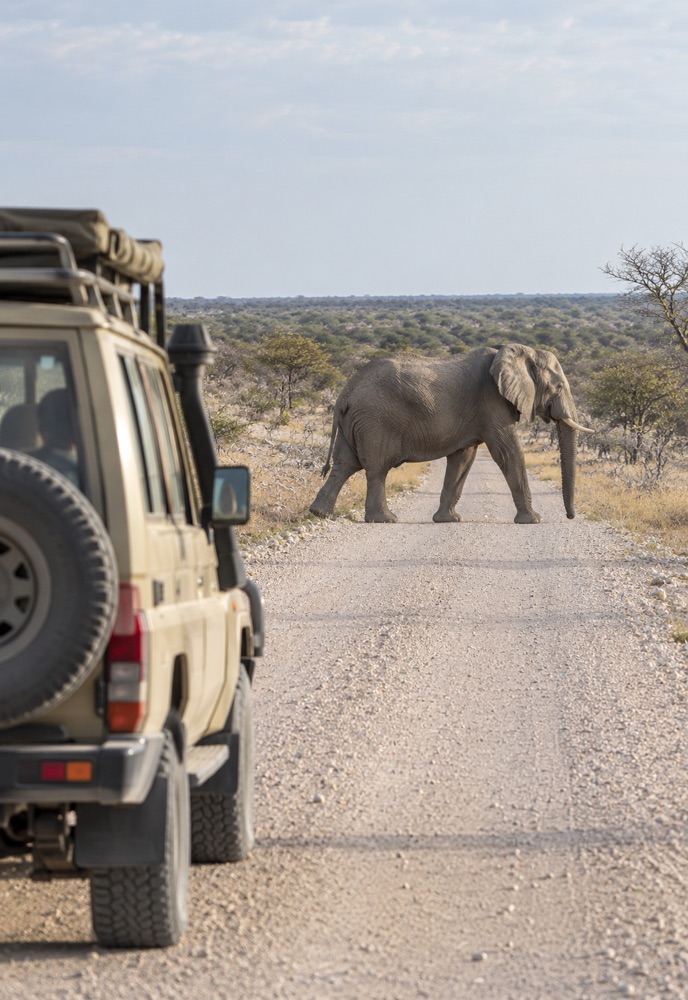
What if an animal blocks the road?
Stop at a safe distance, keep an escape route and wait. Do not hoot, rev or force the animal to move.
FAQ
Can I feed animals in camp?
No. Feeding causes dependence, aggression and conflict and can ultimately harm the animal.
FAQ
Are drones allowed?
Do not assume so. Obtain current official guidance and every required permission before bringing or operating one.
FAQ
Can I collect bones, feathers, plants or stones?
No. Leave natural and cultural material where it is unless current official rules explicitly state otherwise.
FAQ
What if I cannot reach camp before the deadline?
Contact the relevant camp or park authority as soon as safely possible and follow instructions. Do not speed.
FAQ
Where are the legally current rules?
Use permit conditions, official notices, entrance information, signs and instructions from authorised staff.
UNDERSTAND THE RULES, THEN ENJOY THE PARK
Build an itinerary that never depends on rushing or breaking a rule
Choose accommodation and daily loops that fit current operating times, then leave room for wildlife, road conditions and unplanned stops.