
ETOSHA TRAVEL TIPS
Game Viewing in Etosha: A Practical Wildlife-Watching Guide
Excellent wildlife viewing in Etosha comes from reading the landscape, not racing between famous names. This guide explains how to use water, habitat, animal behaviour, light and patient observation to make every self-drive more rewarding.
The most useful question is not “Where is the animal?” but “What is happening here, and what might happen next?”
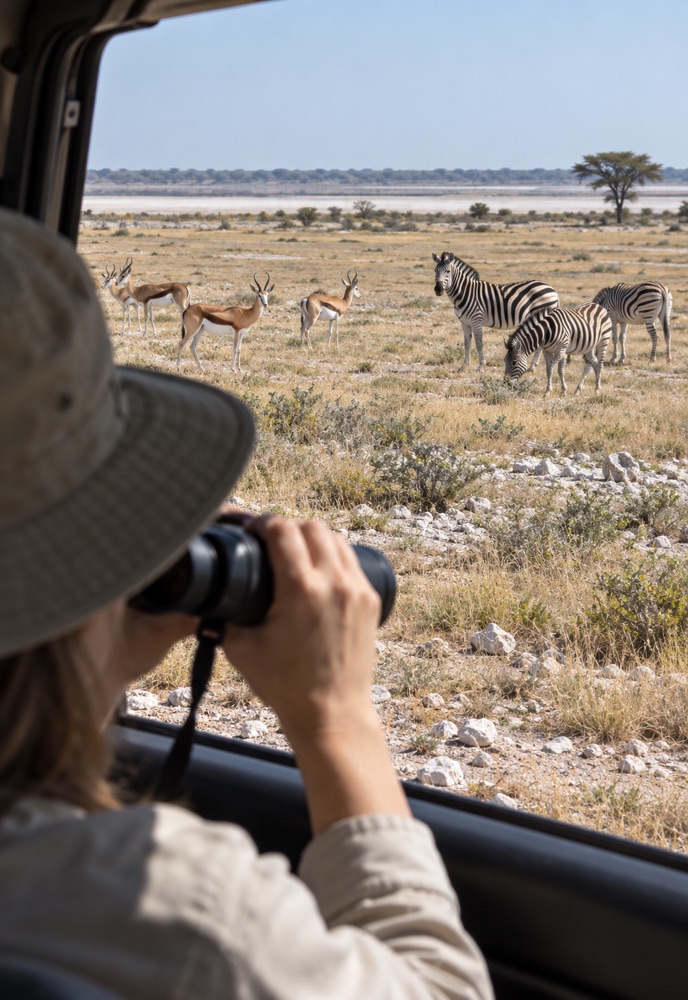
HOW ETOSHA REWARDS ATTENTION
Understand the viewing system before choosing the route
Etosha’s open country, varied habitats and dependence on water create excellent opportunities, but sightings remain wild and unscheduled. These four principles are more useful than chasing someone else’s list.
01
Water shapes movement, but it is not the whole story
Waterholes concentrate activity most strongly when natural water is limited. Animals also move between feeding areas, shade, cover and resting places, so scan the roads and surrounding habitat rather than watching only the water.
02
Patience often beats distance
A quiet stop can become active within minutes. Spending longer at fewer promising locations gives animals time to approach naturally and lets subtle behaviour become visible.
03
The season changes the strategy
Drier conditions can concentrate wildlife near dependable water. During greener periods, animals may spread across the landscape and reward slower habitat-based searching, while birds, young animals and dramatic weather add different interest.
04
Slow observation produces more sightings
Drive slowly enough to notice tracks, ears above grass, a bird watching the ground or herbivores focused in one direction. Fast vehicles usually find only what is already obvious.
READ THE SCENE
Clues that tell you when to stop and look longer
Animals reveal one another through tracks, sound, posture and movement. Learning a few broad clues turns an empty-looking landscape into useful information.
TRACKS
Fresh signs on the road
Clear tracks, disturbed dust, dung or scrape marks can show that an animal passed recently. Note the direction, but do not follow so intently that you stop scanning the wider surroundings.
ALARM
Calls and sudden attention
Repeated alarm calls or several animals staring toward the same cover can indicate a predator or other disturbance. Stop quietly, switch off distractions and watch the direction of their attention.
POSTURE
Body language before movement
Raised heads, clustered herds, tense posture or animals moving away together may signal something unseen. Calm feeding usually tells a different story from alert stillness.
BIRDS
Raptors and scavengers
Vultures circling low, raptors repeatedly using one perch or ground birds reacting sharply can justify a slower scan. Birds often reveal activity long before a mammal becomes obvious.
COVER
Shade, grass and edges
Predators and smaller animals can disappear in surprisingly little cover. Check the shaded side of bushes, tree lines, drainage areas and transitions between open ground and thicker vegetation.
MOVEMENT
Look beyond the obvious animal
When one species is visible, scan its approach and the direction it watches. A herd may be responding to elephants, predators, vehicles or another group just outside your first field of view.
USE OTHER VEHICLES WISELY
A cluster of cars is a clue, not a complete strategy
Stopped vehicles may indicate a sighting, but they can also mark birds, scenery or a simple pause. Approach carefully, keep the road open and scan independently instead of focusing only where the nearest camera points.
USE THE WHOLE DAY WELL
A practical rhythm for game viewing
The first and last light often receive the attention, but every part of the day can be productive when you match your expectations and route to the conditions.
BEFORE DEPARTURE
Start with a realistic loop
Choose a route you can complete comfortably within the park’s current gate and camp times. Allow for slow sightings, rest stops and the possibility that one productive waterhole changes the entire plan.
EARLY MORNING
Scan open ground and road edges
Cooler conditions can favour movement. Look carefully along open plains, woodland edges and the road ahead, and pause where animals are actively feeding, walking or listening.
LATE MORNING
Follow changing priorities
As temperatures rise, animals may move toward water, shade or resting places. This is a useful time to compare nearby habitats instead of racing to a distant name on the map.
MIDDAY
Slow down at water and shade
Midday is not automatically quiet. Elephants, antelope and birds may visit water, while predators can be found resting in shade. Fewer moving animals make patient scanning more important.
AFTERNOON
Work back toward your gate
Build the final hours around a sensible return route. Revisit promising areas if they fit naturally, but never let a sighting tempt you into a rushed or unsafe drive.
TIMING PRINCIPLE
Light and temperature influence behaviour, but they do not guarantee sightings
Treat time of day as a way to refine your search, not as a promise. Weather, water availability, disturbance and chance all affect what you see. A quiet morning can be followed by an exceptional midday encounter.
WATERHOLE STRATEGY
How to turn a stop into meaningful observation
Etosha’s waterholes concentrate opportunity, especially when natural water is scarce. The best results come from arriving calmly, reading the full scene and giving the place enough time to change.
ARRIVE
Approach slowly and quietly
Reduce speed before the final approach. Animals may be beside the road or hidden by other vehicles, and sudden movement can disturb the very behaviour you came to watch.
SCAN
Look beyond the water’s edge
Check the approach tracks, shade, surrounding bush, open ground and sky. Predators often wait away from the obvious centre, while birds and smaller animals use the margins.
WAIT
Give the scene time to develop
A seemingly empty waterhole can change within minutes. Watch which animals look alert, where they face and whether they are making room for something approaching.
POSITION
Protect the sighting and the road
Park so others can pass and so your vehicle does not block an animal’s route to water. If the position is poor, wait for a safe opportunity to move rather than forcing into a gap.
WHEN TO LEAVE
Leave when the scene has settled—or when your presence adds pressure
If activity has stopped, the viewing angle is poor or vehicles are beginning to crowd the approach, moving on can be the better choice. A good safari balances patience with fresh habitat and respectful behaviour.
LOOK FOR BEHAVIOUR, NOT PROMISES
Adapt your search to the wildlife you hope to see
No route can guarantee a particular animal. You can, however, improve your chances by recognising broad habitat preferences, daily needs and the reactions of other wildlife.
ELEPHANTS
Think in terms of space, water and travel routes
Elephants may appear at water in large groups, but they also move widely between feeding areas. Watch distant dust, fresh tracks and the direction of family groups. Give them generous room and never position the vehicle between individuals.
LIONS
Let prey animals help you search
Zebra, wildebeest and antelope often reveal concern through fixed attention, bunching or alarm calls. Scan the direction they are watching, then check shade, grass margins and the bases of trees. Resting lions can disappear into surprisingly little cover.
RHINOS
Choose quiet patience over pursuit
Rhino sightings are never assured. At suitable waterholes or open ground, stay quiet, avoid surrounding the animal and keep a respectful distance. If it changes direction repeatedly, hesitates or appears unsettled, create more space.
CHEETAHS & LEOPARDS
Search the edges and accept rarity
Cheetahs often favour visibility and room to move, while leopards use cover and can be exceptionally difficult to find. Scan termite mounds, woodland margins and shaded branches, but avoid turning a rare sighting into an expectation.
PLAINS GAME
Read the herds, not only the individuals
Zebra, springbok, wildebeest, giraffe and other herbivores provide constant insight. Feeding rhythm, group shape, vigilance and movement can tell you whether the landscape feels relaxed or whether something has disturbed it.
BIRDS & SMALLER WILDLIFE
Make the whole ecosystem part of the safari
Raptors, bustards, hornbills, jackals, mongooses, ground squirrels and reptiles keep a slow period interesting. Paying attention to them sharpens observation and makes the experience richer than a search for a short checklist of famous mammals.
A BETTER EXPECTATION
Aim for meaningful encounters rather than a species total
Wild animals choose where to move and when to appear. The most rewarding viewing often comes from staying with ordinary behaviour long enough for it to become interesting: courtship, feeding, play, competition, vigilance or the careful approach to water.
POSITIONING & ETHICS
Protect the animals, the sighting and other visitors
Good game viewing is measured by more than proximity. Calm positioning preserves natural behaviour, keeps roads functional and gives everyone a fair opportunity to observe.
APPROACH
Reduce speed before joining a sighting
Assume an animal or person may be hidden by parked vehicles. Approach slowly, identify what is happening and stop with enough room to manoeuvre without abrupt movements.
ACCESS
Keep the road passable
Do not create a wall of vehicles. Leave a safe route for traffic, staff and animals, and avoid stopping on bends, crests or narrow sections where visibility is poor.
SPACE
Preserve an escape route
Never box an animal against vehicles, water or vegetation. Keep enough distance for it to cross the road, leave the waterhole or rejoin its group without pressure.
BEHAVIOUR
Let stress signals end the encounter
Repeated alarm, head tossing, mock charges, pacing, flattened ears or a refusal to approach can indicate discomfort. Back away calmly; the animal’s welfare takes priority over a photograph.
SAFETY
Stay inside the vehicle where required
A vehicle provides the predictable shape animals are accustomed to. Follow all current park rules, use only designated places for leaving the vehicle and keep every person fully inside at sightings.
COURTESY
Share the view without directing the scene
Allow others space, keep voices low and limit unnecessary engine noise. Never call, feed, bait or pressure wildlife to change position. Natural behaviour is both safer and more valuable.
OPTICS & PHOTOGRAPHY
Bring tools that help you observe without getting closer
Binoculars and a sensible camera setup improve both identification and enjoyment. Prepare the equipment before the sighting so attention stays on the animal and the road.
BINOCULARS
The most useful viewing tool
A comfortable pair of binoculars reveals behaviour and detail well beyond camera range. Keep them accessible, adjust them for your eyes before the drive and use them from a stationary vehicle.
LENS CHOICE
Reach matters less than stability
A long lens or strong zoom is helpful, but an unstable image is frustrating. Choose equipment you can handle easily inside the vehicle, and avoid leaning far outside for a marginally closer angle.
SUPPORT
Use the vehicle as a steady platform
A beanbag, folded towel or stable window edge can reduce vibration. Switch off the engine when safe and considerate, keep elbows supported and coordinate with other passengers before opening or closing windows.
LIGHT
Prepare for changing exposure
Bright pale ground, deep shade and dark animals can confuse automatic exposure. Check the first image, watch shutter speed and use exposure compensation when needed rather than discovering an entire sequence is unusable later.
DUST
Protect equipment before it becomes a problem
Etosha can be dusty. Change lenses sparingly, keep unused equipment covered and carry a blower or suitable cleaning cloth. Never clean a dusty front element aggressively, as grit can scratch the surface.
STORY
Photograph behaviour and context
Portraits are appealing, but wider frames show habitat, herd relationships and scale. Anticipate interactions, leave room in front of a moving animal and occasionally lower the camera simply to watch.
COMMON MISTAKES
Six habits that reduce the quality of a safari
Most disappointing drives are not caused by an empty park. They come from moving too quickly, narrowing attention too far or letting expectations replace observation.
RUSHING
Trying to cover the maximum distance
A long route can produce fewer meaningful sightings than a short, attentive loop. Slow down where visibility, tracks or animal behaviour justify it, and leave enough time to wait.
FAMOUS STOPS
Visiting only the best-known waterholes
Popular waterholes can be excellent, but wildlife does not follow a tourist itinerary. Include quieter stops and scan the habitat between them; many memorable encounters happen away from a labelled destination.
FOLLOWING CARS
Letting traffic make every decision
Other vehicles can reveal a sighting, but constantly chasing them removes your independence and often places you at the back of a crowd. Use their behaviour as one clue among many.
TUNNEL VISION
Ignoring birds and smaller animals
Searching only for lions, elephants and rhinos makes large parts of the day feel empty. Smaller species, tracks and interactions keep you engaged and often lead to better understanding of the whole scene.
CROWDING
Pushing closer because others have stopped
More vehicles do not make closer positioning acceptable. Stop before the congestion, assess the road and move on if joining would block traffic or pressure the animal.
THE CHECKLIST
Treating every species as an entitlement
A fixed must-see list makes natural variation feel like failure. Set goals around time outdoors, careful observation and varied habitats; any rare sighting then becomes a genuine bonus.
GAME VIEWING FAQ
Practical answers for planning your Etosha safari
These answers set useful expectations without pretending wildlife or park operations are fixed. Always confirm current rules, opening times and activities before travel.
What is the best season for game viewing in Etosha?
The drier months often concentrate wildlife around dependable water and make animals easier to locate, while greener periods bring dramatic landscapes, young animals, migratory birds and more dispersed movement. The best season depends on whether visibility, birding, scenery, temperature or crowd levels matter most to you.
Where am I most likely to see animals?
Waterholes are important, but they are only part of the system. Productive viewing also happens on open plains, woodland edges, along travel routes and wherever prey animals show unusual attention. Use waterholes as anchors and observe carefully between them.
What is the best time of day to drive?
Early morning and late afternoon often offer cooler conditions, softer light and more movement. Midday can still be excellent at waterholes and shaded resting places. Plan around current gate and camp times, then use the whole day rather than writing off several hours.
How long should I wait at a waterhole?
There is no universal rule. Stay longer when tracks, alert animals, distant movement or arriving herds suggest the scene is developing. Move on when activity has settled, the position is poor or congestion is affecting animals and traffic.
May I leave my vehicle while game viewing?
Only leave the vehicle where current park rules specifically permit it, such as designated camps, picnic areas or marked facilities. At ordinary roadside sightings and waterholes, remain properly inside the vehicle and follow all posted instructions.
Do I need binoculars in Etosha?
They are strongly recommended. Binoculars reveal behaviour, birds and distant animals without encouraging a closer approach. They also allow passengers to enjoy the sighting while a photographer is using a camera.
Can I view wildlife after dark?
Independent self-driving is limited to official operating times. Some camps have floodlit waterholes, and guided activities may operate outside ordinary self-drive hours when available. Confirm the current options with the relevant camp or operator.
Is a guided game drive worth it?
A good guide can interpret tracks, behaviour, habitat and subtle signs while someone else handles the driving. Guided drives are especially useful for first-time visitors, travellers who want interpretation or anyone interested in authorised viewing beyond normal self-drive periods.
BEFORE YOU SET OFF
Your game-viewing checklist
A few simple preparations make the drive calmer, safer and far more rewarding once wildlife appears.
Pack, prepare and confirm
✓ Confirm the current gate, camp and activity times.
✓ Choose a conservative route with time for unplanned stops.
✓ Keep binoculars and the camera accessible before departure.
✓ Carry drinking water, sun protection and essential medication.
✓ Clean windows and check fuel, tyres and basic vehicle readiness.
✓ Download or carry a map and know the return route.
✓ Agree on quiet behaviour and safe window use with passengers.
✓ Leave the checklist mentality behind and watch what unfolds.
CHOOSE THE GUIDE, THEN BUILD THE SAFARI
Turn better observation into a better Etosha itinerary
Choose accommodation that supports realistic daily loops, use the map to connect waterholes and habitats, and ask us for help if you want a route shaped around your available time and travel style.