
ETOSHA TRAVEL TIPS
Etosha’s Fairy Tale Forest: A Guide to the Moringa Landscape
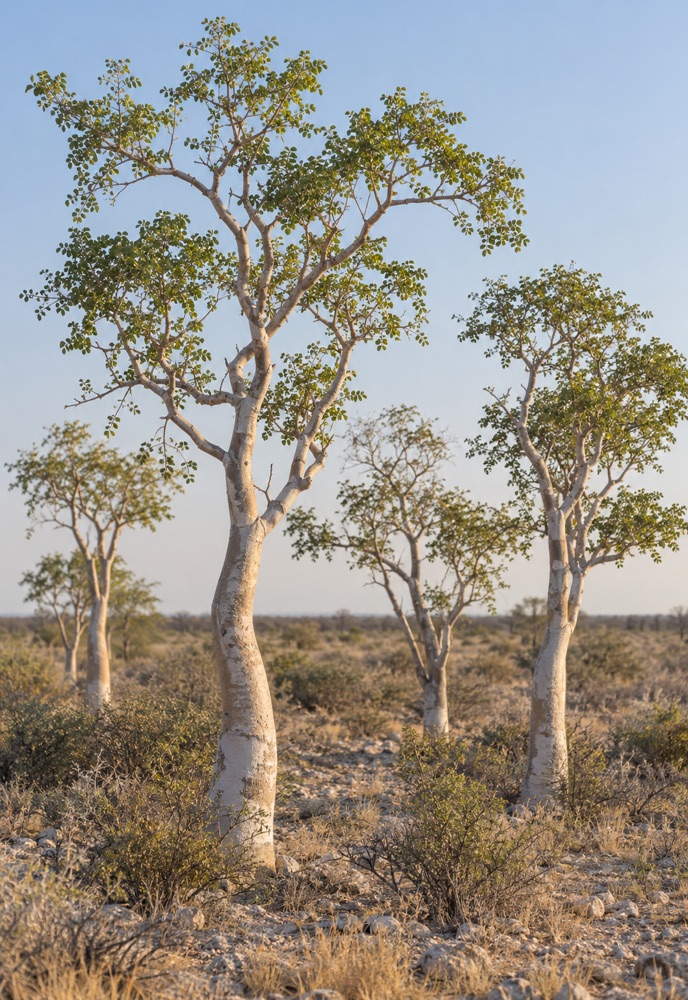
Fairy Tale Forest is one of Etosha’s most distinctive botanical landscapes: a concentration of sculptural Moringa ovalifolia trees rising from open country where visitors may not expect to find them.
Visit for form, ecology and atmosphere—not for a guaranteed wildlife encounter. Access and road conditions should always be confirmed locally.
WHY THE FOREST IS DISTINCTIVE
The interest lies in an unusual concentration, not a conventional dense forest
The name suggests woodland, but the experience is more sculptural: widely spaced, pale-trunked trees set against Etosha’s open landscape.
FORM
Each tree has an individual silhouette
Swollen trunks, sparse branching and weathered shapes make the trees feel almost architectural.
SETTING
The open plain changes how the species is perceived
Moringas are often associated with rocky slopes elsewhere, making this concentration in flatter country visually unusual.
SCALE
The landscape rewards slow observation
Look beyond a single famous tree and notice spacing, age, damage, regrowth and the relationship to the horizon.
ATMOSPHERE
Light and weather transform the scene
Soft morning light, late-afternoon warmth, cloud and dust create very different versions of the same place.
MORINGA OVALIFOLIA
Understand the tree before photographing the legend
Moringa ovalifolia is a southern African stem-succulent tree adapted to dry environments. Its pale trunk and sparse crown store and conserve resources in ways suited to harsh conditions.
TRUNK
The swollen stem is part of the adaptation
Its form stores water and supports survival through dry periods rather than serving as ornamental shape.
BARK
Pale, smooth surfaces reflect the environment
Marks, scars and browsing damage reveal the tree’s history and interaction with weather and animals.
LEAVES
Foliage changes with conditions
The crown may look sparse or fuller depending on season and recent moisture.
FLOWERS & SEED
Reproduction is easy to overlook
Visitors focused on the trunk may miss smaller seasonal details that help identify the living plant.
RANGE
The species extends beyond this one site
The forest is notable for its concentration and setting, not because every individual moringa exists only here.
NAME
Avoid confusing it with cultivated moringa
Different Moringa species have different ranges and uses. This page concerns Moringa ovalifolia in its natural landscape.
A FOREST ON THE PLAINS
Landscape context is the reason the stop feels surprising
The relationship between tree, soil, rock, drainage and open space matters as much as the species name.
TOPOGRAPHY
Compare the plain with distant rocky country
The wider view helps explain why the setting feels different from typical hillside occurrences.
SOIL
Notice where individuals establish
Subtle changes in surface, drainage and disturbance can influence which trees persist.
SPACING
Look for patterns rather than density
Age, browsing and survival create an irregular arrangement with large areas of negative space.
HORIZON
Use Etosha’s scale
The low horizon makes each trunk prominent and gives photographs a strong sense of isolation.
SEASON
Dry and green periods tell different stories
Dust and bare form emphasise endurance; fresh growth and storm light emphasise renewal.
TIME
Return is not repetition
Light and weather can change the forest more dramatically than moving to a different viewpoint.
ELEPHANTS, BROWSING & CHANGE
Damage is part of a living ecological relationship
Elephants may browse or push moringas, and visible damage can feel alarming. The responsible response is observation, not intervention.
BROWSING
Feeding leaves marks
Broken branches and stripped areas record how large herbivores use the plant.
PRESSURE
Individual trees experience different outcomes
Some recover, some change form and some are lost. A static photograph cannot explain the whole population.
DISTANCE
Never approach an elephant-tree interaction
Stay inside the vehicle and allow animals a clear route through the area.
NO REPAIR
Do not touch, prop or alter damaged trees
Intervention by visitors can cause further harm and removes evidence important to natural processes.
NO COLLECTION
Leave bark, branches and seeds where they are
Natural material remains part of the ecosystem and is protected by park rules.
CONTEXT
Avoid turning damage into a villain story
Elephants and moringas are both part of the landscape. Responsible interpretation recognises complexity rather than assigning blame.
PLANNING THE STOP
Fit the forest into a comfortable western-area route
The location is best treated as part of a broader loop rather than a hurried detour. Confirm the current road, access and return time before committing.
MAP
Locate it relative to your camp and turnaround
Know how the stop affects the return route before leaving the main planning point.
TIME
Allow for slow driving and wildlife
The road can produce sightings that matter more than the estimated arrival time.
ACCESS
Use authorised roads and viewing positions
Do not leave the road or vehicle to approach a more photogenic tree.
WEATHER
Consider heat, glare and storms
The open setting offers little protection. Carry water, sun protection and a flexible plan.
STOP LENGTH
Give the place more than a drive-by glance
A short, quiet scan reveals details in trunks, spacing and birdlife that disappear at speed.
RETURN
Set a firm decision time
Remove an optional waterhole rather than turning the final part of the day into a rush.
OBSERVATION & PHOTOGRAPHY
Keep compositions simple and the landscape honest
Fairy Tale Forest rewards attention to form, texture and scale. The strongest images usually use fewer elements, not more equipment.
PORTRAIT
Isolate one tree
Use the open background to show shape, scars and branching without visual clutter.
WIDE
Show the concentration
Include several trees and the horizon to explain why the site feels unusual.
LIGHT
Work with side light where possible
Raking light reveals trunk texture and separates pale bark from the sky.
SKY
Use cloud or empty space deliberately
A clean sky emphasises form; storm clouds add atmosphere without inventing drama.
WILDLIFE
Let animals remain secondary when appropriate
An elephant or antelope can provide scale, but never pressure wildlife into the composition.
FOOTPRINT
Photograph from legal positions
No image justifies leaving the road, trampling vegetation or touching a tree.
ROUTE CONTEXT
Combine the forest with nearby habitat, not a checklist sprint
The journey becomes more useful when the forest is one chapter in a day that also includes open plains, waterholes and patient scanning.
OUTBOUND
Observe the landscape changing
Note when vegetation, soil and views begin to differ from the camp surroundings.
WATERHOLES
Choose only those that fit naturally
Add nearby stops without extending the loop beyond a safe return margin.
WILDLIFE
Scan continuously between named places
Many memorable sightings occur on the road rather than at the destination.
RETURN
Use a different legal loop when practical
Contrasting habitat can make the return as interesting as the outward drive.
BEFORE VISITING
Fairy Tale Forest checklist
A careful visit protects the landscape and leaves enough time for the rest of the route.
01
Confirm current access
Use staff advice and road signs.
02
Check the return time
Build a conservative margin.
03
Carry an offline map
Know the turnaround before signal disappears.
04
Bring water and sun protection
The landscape is open and exposed.
05
Prepare a simple camera setup
Avoid dusty lens changes.
06
Stay on authorised roads
Do not approach trees on foot.
07
Leave natural material untouched
Take photographs, not souvenirs.
08
Let wildlife control the scene
Never reposition an animal for an image.
FAIRY TALE FOREST FAQ
Answers for planning and understanding the stop
Use these answers as orientation, then confirm roads and operating conditions locally.
FAQ
Is Fairy Tale Forest a dense forest?
No. Its character comes from distinctive moringa trees spaced across open country.
FAQ
What species are the trees?
The defining species is Moringa ovalifolia, a southern African stem-succulent tree.
FAQ
Why are they called upside-down trees?
The sparse branching and swollen trunks create the appearance associated with the name and with regional stories.
FAQ
Will I see elephants there?
Wildlife cannot be guaranteed. Elephants use the wider landscape and may browse moringas, but the visit should not depend on seeing them.
FAQ
Can I walk among the trees?
Only if current rules and a designated area explicitly permit it. Otherwise remain in the vehicle on authorised roads.
FAQ
When is the best light?
Morning and late afternoon often give softer light, but the route must fit current operating times.
FAQ
How long should I spend there?
Allow enough time to observe and photograph without making the rest of the loop rushed.
FAQ
Is it worth visiting in the green season?
Yes. Fresh growth, cloud and colour produce a different visual story from the sculptural dryness of later months.
MAKE THE FOREST PART OF A REALISTIC WESTERN LOOP
Plan enough time to notice what makes the landscape unusual
Choose accommodation and a route that place Fairy Tale Forest within comfortable reach, then combine it with nearby habitat and waterholes without rushing.